In mathematics, the inverse trigonometric functions (occasionally also called antitrigonometric, [1] cyclometric, [2] or arcus functions [3]) are the inverse functions of the trigonometric functions, under suitably restricted domains.
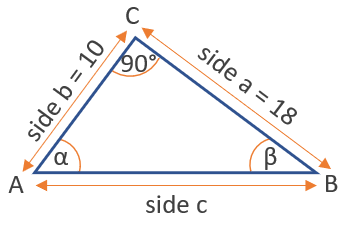
While we can find the value for arctangent for any x value in the interval [-∞, ∞], there are certain angles that are used frequently in trigonometry (0°, 30°, 45°, 60°, 90°, and their multiples and radian equivalents) whose tangent and arctangent values may be worth memorizing.
Online arctangent calculation tool to compute the arcus tangens function in degrees or radians. Supports input of decimal numbers (0.5, 6, -1, etc.) and fractions (1/3, 3/4, 1/6, -4/3 etc.).
In trigonometry, arctan refers to the inverse tangent function. Inverse trigonometric functions are usually accompanied by the prefix - arc. Mathematically, we represent arctan or the inverse tangent function as tan -1 x or arctan (x).
Use arctan when you know the tangent of an angle and want to know the actual angle. In the above figure, click on 'reset'. We know the side lengths but need to find the measure of angle C. Using a calculator we find arctan 0.577 is 30°. Recall that we can apply trig functions to any angle, including large and negative angles.
Use this arctan calculator to quickly find the inverse tangent. Whether you're looking for a simple answer to the question "what is an arctan?" or are curious about the integral or derivative of arctan, you've come to the right place.
In trigonometry, the arctangent is the inverse of the tangent function. It's often written as arctg, arctan, tg -1, or tan -1. $$ y = arctan \ x $$ Here, x represents the value of the tangent. The arctangent function returns the angle y corresponding to the given tangent value. $$ y = \ arctan \ x $$ Where x is the tangent value. $$ x = \tan y $$
Arctan is defined as the inverse of the tangent function. Arctan (x) is denoted as tan-1(x). There are six trigonometric functions and the inverse of all six functions is repressed as, sin-1x, cos-1x, tan-1x, cosec-1x, sec-1x, and cot-1x.